Service Overview
General spraying alone is often not enough for recurring cockroach cases. Site-specific treatment that targets the actual harbourage zones, combined with moisture and food-source reduction, is what breaks the breeding cycle. Uni Smart Pest Control's cockroach program starts with a detailed inspection to identify the species, locate the nesting zones, and assess moisture and food-source factors. The treatment is then scoped to the specific situation rather than a generic spray. Cockroach treatment in Malaysian homes typically involves gel bait placement at harbourage zones, targeted crack-and-crevice application where the bugs travel, and a residual perimeter spray at active entry points. For severe or recurring cases, a follow-up visit at 2 to 4 weeks catches newly hatched nymphs. The combination of these methods is what works. Skipping any one of them usually leads to recurrence within 1 to 2 months.
Uni Smart Pest Control plans include a detailed inspection to identify species, map active zones, and apply the right treatment to each harbourage point. We also provide practical next-step guidance to reduce conditions that attract cockroaches back into the property.
In Malaysian urban homes, cockroach problems are most common in high-density residential areas where units share walls, plumbing chases, and refuse rooms. German cockroaches (Blattella germanica) are the most common species in apartments and condos because they spread easily between units through shared service risers. American cockroaches (Periplaneta americana) are larger and more common in terrace and landed homes, particularly in kitchen and bathroom areas. Oriental cockroaches (Blatta orientalis) prefer cooler, damper areas like basements and drains. Each species needs a different treatment approach. German cockroaches respond best to gel bait placement in harbourage zones, while American and Oriental cockroaches respond better to perimeter and drain treatment.
Restaurant and commercial kitchen cockroach control requires additional focus on documentation, audit trails, and rapid response to health inspector concerns. Uni Smart Pest Control offers monthly or bi-monthly service contracts for F&B and food-grade facilities with written service reports after every visit. Treatment timing is scheduled around operational hours to avoid disruption. The same species identification and treatment framework is used, with extra attention to drain lines, refuse areas, and food preparation surfaces.
Species identification
German and American cockroach behavior differs — accurate identification determines where and how we apply treatment for maximum effect.
Harbourage mapping
We locate hidden nesting zones behind kitchen cabinets, inside wall cavities, near drains, and under appliances where sprays typically cannot reach.
Gel bait rotation
Modern cockroach control uses gel baits placed at active points rather than broad chemical spraying, reducing exposure risk in occupied spaces.
Drain and perimeter treatment
Drain entrances and the exterior perimeter of the property are treated to prevent cockroaches migrating in from sewer lines or neighboring units.
Sanitation guidance
Technicians advise on the specific housekeeping changes that most reduce cockroach attractants in your property type and usage pattern.
Follow-up monitoring
Scheduled revisit checks confirm that activity has reduced and identify any rebound zones that need retreatment.
Cockroach in Malaysia: the conditions behind most infestations
Cockroach activity in Malaysian properties is rarely a coincidence of chance. It follows heat, moisture, food and shelter, and in a dense urban area it follows the building as much as the building's own conditions. Shared service risers, refuse rooms and pipe chases connect units that have no other connection, which is why a problem in one apartment is often visible in several. The practical implication is that the property cannot be treated in isolation. Reducing what is available in the building as a whole — waste management, shared service spaces, and the condition of the risers and drains — is part of controlling cockroaches in any one unit.
- Heat and humidity in sheltered voids provide the conditions populations need to breed
- Water from leaking pipes, dripping air-conditioning units and floor drains sustains them
- Food waste and unsealed refuse in shared areas support the whole building, not one unit
- Service risers, pipe chases and refuse rooms carry cockroaches between stacked units
- Refurbishment, moving in and new fit-outs often bring an infestation with them
Cockroaches control: how a cockroach population is actually broken
A cockroach population is not broken by killing the adults you can see. Most of the population is eggs and nymphs hidden inside harbourage, protected by the same surfaces the adults travel along. Broad spraying kills the visible fraction and leaves the breeding cycle intact, which is why an infestation treated that way returns within a month or two. What breaks the cycle is reaching the harbourage, where the eggs and the nymphs are held, and applying something the insects carry back into it rather than something that only touches the surfaces they walk across.
- Egg cases and young nymphs are concealed, so treatment has to reach the harbourage itself
- Contact spraying along a visible trail removes the adults and leaves the cycle running
- Gel bait and slow-acting formulations work because the insect carries them back to the harbourage
- Drain and perimeter treatment close the routes adults use to move between units and into the building
- Moisture and food removal decide whether the population returns after the treatment
Cockroach pest control: the methods and when each is used
Four methods carry most of the work, and each has a situation it suits and a situation it does not. The selection follows from the inspection findings rather than from the species alone, because the same species behaves differently in a dry service yard and a wet refuse room. Used together in the right proportion, they cover the harbourage, the routes and the outside. Used in isolation, each one leaves a gap that the infestation returns through.
- Gel bait placed at harbourage points — the primary method where the population is established indoors
- Residual crack-and-crevice application where insects travel along edges, hinges and frame joints
- Drain treatment where activity is coming from the waste or drainage system
- Perimeter treatment along the exterior line to stop new cockroaches moving in from outside
- Monitoring stations or scheduled revisits where the infestation is heavy or has recurred before
Pest control for cockroaches: what a visit includes
A cockroach visit is more than a spray, and the written scope is what makes the difference between a treatment and a service. It should state what was found, which methods were applied where, what the property needs to change, and when the follow-up falls. Most residential cockroach work is a first visit and a review. The review is not optional: nymphs that were protected when the first treatment was applied will emerge afterwards, and that emergence is what the second visit is there to catch.
- Inspection of all accessible areas to identify the species, active zones and entry points
- A written scope stating the treatment for each harbourage zone before anything is applied
- Clear preparation guidance so surfaces and belongings are not in the way of the application
- Re-entry and safety guidance given at the end of the visit, not only in writing afterwards
- A follow-up visit scheduled to confirm the reduction and retreat any remaining hot spots
Pest control roaches: recognising an infestation early
Cockroaches are nocturnal and hide well, so the evidence they leave is more useful than a sighting. Most infestations are confirmed long before anyone sees an adult in the open, and the first confirmation is usually a sign rather than a sight. Finding these early changes the outcome. A population caught at the harbourage stage is a contained problem; the same infestation found six months later involves multiple rooms, multiple units and a considerably larger treatment scope.
- Droppings — small dark specks that look like ground pepper, often along skirting boards and inside cupboards
- Egg cases — small brown capsules, usually deposited in sheltered harbourage near sinks and appliances
- Shed skins and droppings together near a kitchen or bathroom, often behind the refrigerator
- A musty smell in enclosed spaces such as cupboards, risers and under stairs
- Live sightings during the day, particularly in a bathroom, which suggests the population is already large
Preventing cockroaches from returning after treatment
Treatment removes the population. Prevention is what stops the building putting a new one in place, and most of it is ordinary housekeeping that the inspection report should specify rather than leave to memory. The conditions that decide the outcome are consistent: water that should not be there, food that is not covered, and gaps that are not sealed. Where those three are addressed, the follow-up visit usually finds very little remaining activity.
- Fix leaking pipes and dripping air-conditioning units, and keep floor drains covered
- Store food in sealed containers and clean crumbs from under appliances and along skirting
- Take rubbish out on schedule and keep bins lidded, away from the building and off the ground where possible
- Seal gaps around pipe penetrations, under doors and along the skirting line
- Keep refuse rooms, service corridors and shared risers on a cleaning schedule
Cockroach control pricing in Malaysia
Cockroach control starts from RM 200 for selected residential properties with a defined scope. Beyond that, the quote follows the infestation rather than the building: the number of harbourage zones, whether activity has reached the drains or the neighbouring units, and whether the work is a single treatment or a programme. Commercial kitchens are quoted differently because the requirement is different. The cost that matters on a food site is not the visit but the documentation, the response time and the audit trail behind it.
- The RM 200 starting figure covers a defined scope on a selected residential property
- The number of harbourage zones and the extent of the activity set the base price
- Drain treatment and multi-unit building coverage are scoped separately
- Commercial kitchens and food-grade sites are quoted as a programme with a visit schedule
- Follow-up visits are quoted separately where the infestation is heavy or has recurred before
How this service works
- Inspect all accessible areas to identify cockroach species, active zones, and likely entry points.
- Map high-activity harbourage zones — typically kitchen cabinets, under sinks, behind refrigerators, and near floor drains.
- Apply targeted gel bait at each identified zone alongside a perimeter treatment around drains and entry gaps.
- Provide a written sanitation and prevention checklist tailored to the property.
- Schedule a follow-up inspection 7–14 days later to assess reduction and retreat any remaining hot spots.
Related pages
Continue to the most relevant next page for service details, location coverage, pricing, and FAQs.
Frequently asked questions
How much does professional cockroach control cost in Malaysia?
Cockroach control starts from RM 200 for selected residential properties with a defined scope. The final quote depends on the number of harbourage zones, whether activity has reached the drains or adjoining units, and whether follow-up visits are included. Commercial kitchens are quoted as a programme.
How do I prevent cockroaches from entering my home?
Seal gaps under doors and around pipe penetrations, keep food in sealed containers, take rubbish out on schedule, fix leaking pipes and dripping air-conditioning units, and keep floor drains covered. In apartment blocks, keeping refuse rooms and service corridors clean matters as much as anything inside your own unit.
Why do cockroaches return after treatment?
Usually because the breeding cycle was never reached. Visible adults are a small fraction of the population, and the eggs and nymphs stay protected inside harbourage. Treatment that only touches the surfaces insects walk across leaves the cycle running, so the infestation returns within a month or two. It can also return if the moisture, food or access conditions were not addressed.
Is cockroach treatment safe for homes with children and pets?
The methods used are selected for the site and applied to the harbourage rather than sprayed across living areas. You will receive preparation, re-entry and safety guidance for the specific application. Households with very young children, pets with respiratory issues, or pregnant occupants should tell us before the visit so the product selection and timing can be adjusted.
How long does it take to get rid of a cockroach infestation?
Visible activity usually drops within days of the first treatment, because the harbourage and the routes are treated together. Complete clearance depends on the scale of the infestation, the number of units affected and how much of the building's own conditions were corrected. A follow-up visit at 7 to 14 days catches the nymphs that were protected during the first application.
What do cockroaches look like and how do I identify them?
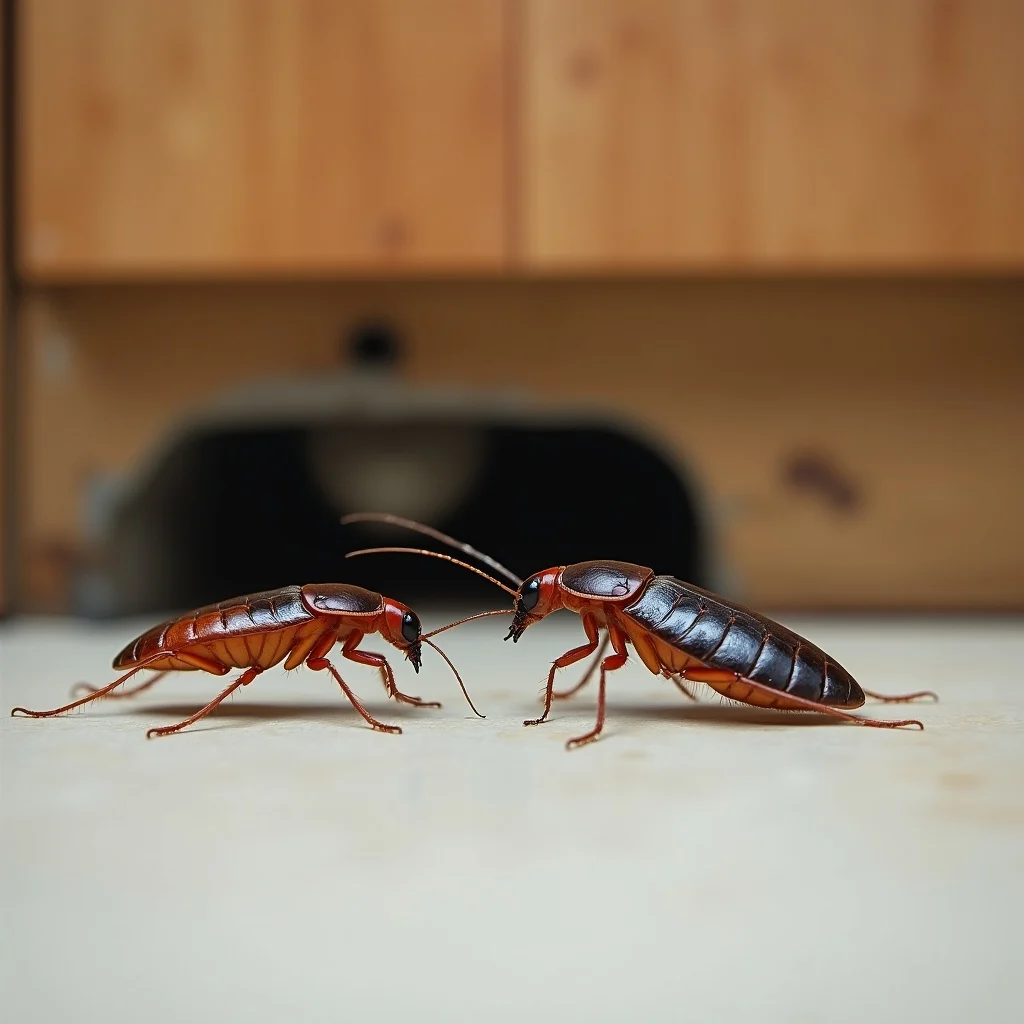
German cockroaches are small, light brown, and carry two dark parallel lines down the back. American cockroaches are much larger, reddish-brown, and have a pale figure-eight marking behind the head. Oriental cockroaches are dark and glossy, and prefer cool damp areas such as basins, drains and basements. The species determines where the treatment is placed, so identification is part of the inspection.
How soon after treatment can I use my kitchen again?
Re-entry guidance is given at the end of the visit and depends on the products used in each area. We do not quote a single figure in advance because the answer changes with the method and the site. Please follow the guidance you are given on the day rather than an assumed time.
Do you provide service reports for restaurants and food businesses?
Yes. Food businesses receive a written service report after every visit covering the areas treated, the methods applied and the guidance issued, with treatment timed around your operating hours. Monthly or bi-monthly contracts are available with the audit trail maintained for your own records.
About the business
Uni Smart Pest Control is a Malaysian-registered pest control company operating since 2002. The technical content on this page is written and reviewed by the company itself, not by an individual.
- Author
- Uni Smart Pest Control Sdn. Bhd.
- Technical reviewer
- Uni Smart Pest Control Sdn. Bhd.
- SSM registration
- 202001020657 (1376977-D) Incorporated 2 January 2020
- Service coverage
- Kuala Lumpur, Selangor and Putrajaya
Credentials: PAL — Licensed Pesticide Applicator · APAL — Assistant Pesticide Applicator · PCAM member
Last reviewed: 11 November 2026
Next step
Tell us your property type and pest issue. We will recommend the most suitable treatment route and timeline.