
Service Overview
Fogging is the application of a pesticide as a fine airborne mist to reduce the numbers of flying insects in an area at the time of application. It is a useful tool against mosquitoes and some flying insects, and it works quickly for a visible nuisance problem. It is also a treatment with a short half-life and no residual effect. What is in the air deposits, breaks down and is gone within hours. For that reason fogging works best as one part of a broader mosquito and vector-control strategy rather than as a standalone long-term fix, and it is the wrong tool for the problems most people actually call about.
The distinction worth holding onto is between a flying-insect problem and a crawling-insect problem. Fogging reaches what is airborne at the moment of application. Cockroaches, ants and rodents live in harbourages that fogging does not reach at all, and a fogging visit for any of them is a wasted appointment. Best results come from combining source reduction, habitat management, and scheduled treatment when risk conditions require it. Removing standing water and managing waste matters more over a season than any single fogging visit.
In Malaysia the mosquito pressure that drives fogging demand is seasonal and is closely tied to rainfall and to the way water is managed around a property. Dengue is transmitted by the Aedes mosquito, which breeds in small domestic containers rather than in open drains. That matters for how fogging is positioned: it can reduce adult numbers during an outbreak, but it does nothing about the containers the next generation comes from. Fogging in Malaysia is therefore normally scheduled around a specific risk window or a confirmed complaint pattern, rather than run as a fixed calendar treatment.
Targeted use
Fogging is deployed based on site risk, timing, and exposure profile, not applied on a fixed rotation.
Residential and commercial
Suitable for selected homes, compounds, and operational sites where the assessment supports it.
Integrated approach
Combines fogging with breeding-source and sanitation controls, which is where the lasting result sits.
Follow-up planning
Repeat schedules are adjusted using on-site activity trends rather than kept to the original plan.
Safety-led application
Preparation, re-entry time and protection of people, pets, food and water are confirmed before the visit.
Written service record
Commercial sites receive a record of the application, the guidance issued and the follow-up scheduled.
Fogging: what it is and how it works
Fogging disperses a pesticide into the air as a fine mist so that flying insects are exposed while they are in flight. The application is quick, the visible result can be impressive, and the treatment has no continuing presence once it has deposited and broken down. That last point is what decides where fogging belongs in a pest control plan. It is a population-reduction tool for a specific moment, not a barrier, and it does not protect a property from the next wave of insects arriving from outside it.
- The mist settles onto surfaces and breaks down within hours rather than persisting as a barrier
- It reduces the number of flying insects present during and shortly after the application
- It has no effect on eggs, larvae or breeding sites
- It does not reach harbourages, so it does not treat cockroaches, ants or rodents
- Repeated frequent fogging without source control tends to produce short-lived results
Fogging in Malaysia: climate, mosquito pressure and service scope
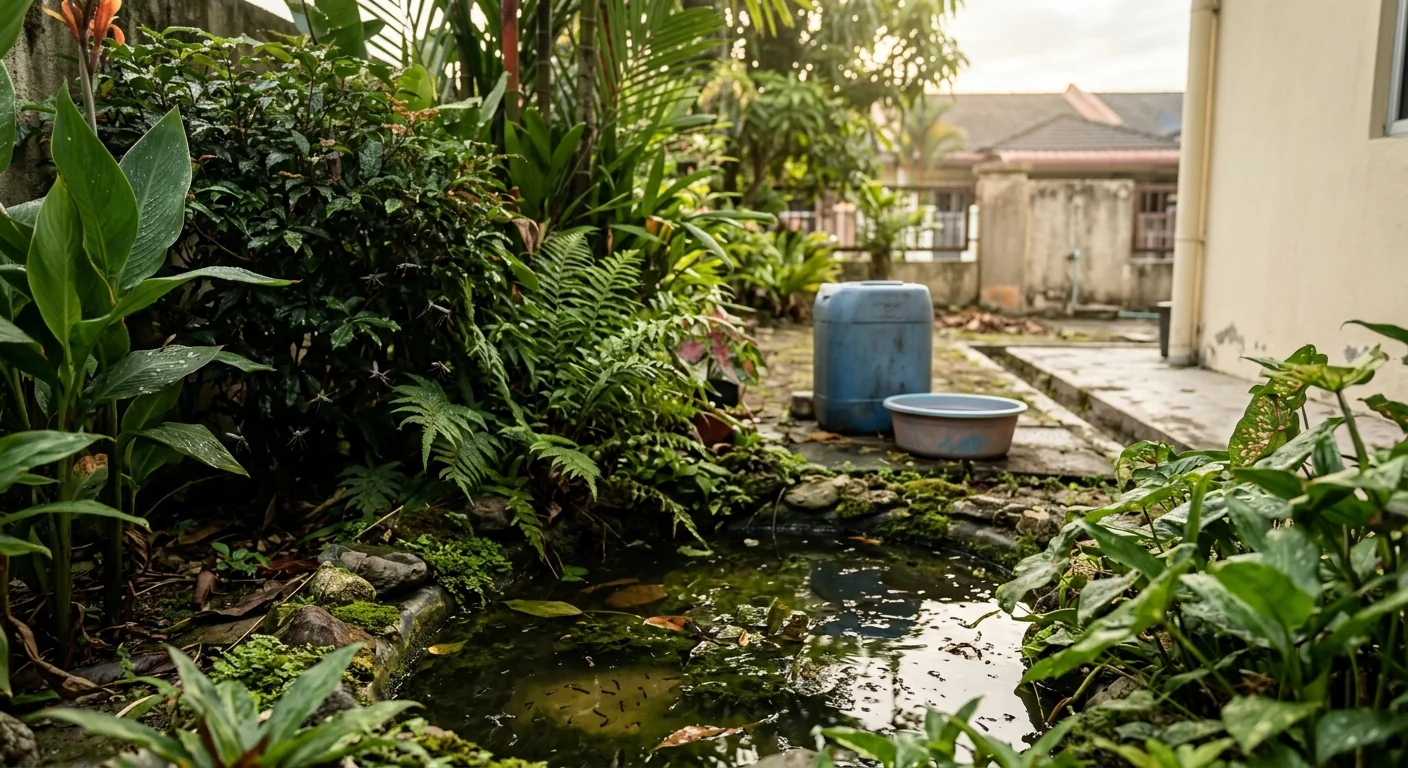
Fogging in Malaysia is usually requested against mosquito activity, and the demand follows the rainfall pattern and the way water is managed around the property rather than a fixed calendar. The Aedes mosquito that transmits dengue breeds in small domestic containers — plant pot trays, buckets, roof gutters, discarded tyres and uncovered water storage — and those are the things that determine how quickly populations recover. Our service scope across Kuala Lumpur, Selangor and Putrajaya is set by site assessment. For residential compounds the work is usually a scheduled outdoor application covering the perimeter and the shaded, humid areas where adult mosquitoes rest. For commercial sites the scope is agreed against the operating pattern, so the application fits around the working day.
- Outdoor perimeter and shaded resting areas are the usual target in residential compounds
- Rainfall and standing water drive the pressure that fogging is responding to
- Commercial scopes are agreed around operating hours so the application fits the working day
- Source reduction advice is included because it determines whether the result lasts
- Schedules are reviewed against activity rather than left running at the original interval
Is fogging safe for homes with children and pets?
Fogging can be safe when it is done to a product's label directions and to a professional safety assessment, and the safety of the household rests on how carefully that preparation is followed. The label directions for the product being applied are the controlling document, and the re-entry guidance issued on the day is specific to the property, the application and the product. We would rather state the limits plainly than offer a general assurance. Fogging is not appropriate for every property, and in some cases it is not the right answer at all. Where a household has very young children, pets with respiratory conditions, pregnant occupants, a fish pond, an apiary, or a food preparation area, we adjust the product selection, the timing and the application method accordingly, and we will tell you when the correct answer is to not fog at all.
- Preparation usually means removing food, water, toys, pet bowls and bedding from the treatment area
- People and pets must be out of the treated area for the re-entry period stated on the day of the application
- Cover or remove aquariums, fish ponds and beehives, which are affected by airborne pesticide drift
- Re-entry guidance is specific to the product, the application and the property, and should be followed exactly
- Households with infants, pregnant occupants or pets with respiratory conditions need to be discussed before the visit
Fogging or misting: which one the site needs
Fogging and misting are often used interchangeably, but they are different applications with different equipment and different results. Fogging produces a very fine airborne mist that disperses widely and settles over a broad area. Misting produces a heavier, more directed spray, which is usually delivered from a fixed point along a wall or fence line and does not fill a space. Neither is a substitute for the other. Fogging suits a broad, short-duration reduction in flying insects across an outdoor area. Misting suits a sustained barrier along a boundary where flying insects enter repeatedly. We will tell you which one the site actually needs rather than defaulting to one.
- Fogging disperses a fine mist that settles across a broad area for a short period
- Misting delivers a directed spray, typically along a wall or perimeter line
- Fogging suits outdoor areas and short-term reduction in flying insects
- Misting suits a repeated entry route along a boundary
- Neither approach replaces source reduction or habitat management
What a fogging visit covers, step by step
The visit is structured around assessment, application and follow-up rather than starting with the machine. Site conditions are inspected, we confirm whether fogging is the appropriate response for that risk profile, the application is carried out with the operational and safety guidance issued at the time, and the follow-up prevention and monitoring actions are planned. For residential compounds the most useful part is often the last one. The list of standing water, containers and access points that we find is what determines whether the next month is quiet or not.
- Inspect site conditions and identify where flying insects are resting and breeding
- Confirm whether fogging is appropriate for the risk profile, or whether source control is the better first step
- Carry out the application with operational and safety guidance issued on the day
- Plan follow-up prevention and monitoring, including the source reduction list for the property
Fogging pricing in Malaysia
Fogging is quoted on the scope of the application rather than on a single flat rate, because the same word covers a small residential compound application and a multi-site commercial programme. The determining factors are the treated area, whether the application is indoor or outdoor, how many visits are needed to cover the period, and how much source reduction advice is part of the scope. Scheduled programmes are priced per visit at a lower rate than one-off applications, which is the practical way to keep the coverage continuous through a mosquito season.
- The treated area and whether the application is indoor or outdoor set the base scope
- Scheduled programmes price each visit below the equivalent one-off application
- Source reduction advice is quoted as part of the scope where the property needs it
- Commercial multi-site programmes are quoted against the number of sites and the visit schedule
- Request a site visit for a quote specific to your property rather than a generic rate
What fogging does not solve
Fogging reduces what is flying. It does not remove where they came from, and it does not stop the next generation. For a household with recurring mosquito activity, the thing that changes the pattern is removing the containers and standing water that the next brood develops in. There are also problems fogging is simply the wrong tool for. Cockroaches, ants and rodents live in harbourages it never reaches. A property with a bed bug problem, a termite colony or a cockroach infestation needs a different treatment entirely, and a fogging visit will not move it forward.
- It does not remove breeding sites, so populations recover from untreated containers
- It does not reach harbourages, so it does not treat cockroaches, ants or rodents
- It does not treat bed bugs or termites, which need their own inspection-led programmes
- It does not protect against the next wave arriving from outside the treated area
- Used repeatedly without source control, it can become an expensive habit with a short-lived result
How this service works
- Inspect site conditions and identify vector hotspots.
- Confirm whether fogging is appropriate for the risk profile.
- Execute treatment with operational and safety guidance.
- Plan follow-up prevention and monitoring actions.
Related pages
Continue to the most relevant next page for service details, location coverage, pricing, and FAQs.
Frequently asked questions
Is fogging enough to stop mosquitoes permanently?
Fogging alone is usually temporary. Long-term control needs source reduction and preventive site management.
Can fogging be scheduled for commercial premises?
Yes. Uni Smart Pest Control can schedule fogging support for suitable commercial site requirements, with the application timed around your operating pattern and a written service record for your files.
How often should fogging be done?
Frequency depends on site risk, season, and complaint history. A schedule is set after a site assessment and reviewed against observed activity rather than left running at the original interval.
Is fogging safe for homes with children and pets?
It can be, when the application follows the product label directions and a professional safety assessment. People, pets, food and water must be protected as instructed, and the re-entry time should be confirmed on the day rather than assumed. Households with infants, pregnant occupants or pets with respiratory conditions need to be discussed before the visit.
How long after fogging can I re-enter my home?
The re-entry time depends on the product used and the label directions for that product, and it is confirmed on the day of the application. It is not a fixed figure we can quote in advance, and anyone giving you one without naming the product and its label is guessing.
Does fogging help with dengue?
Fogging can reduce adult mosquito numbers during an active outbreak, which is why it is used that way. It does not remove the breeding sites, because the Aedes mosquito that transmits dengue breeds in small domestic containers. Treating the containers matters more over the following weeks.
What does fogging cost in Malaysia?
Fogging is quoted on the scope of the application rather than a flat rate. The treated area, whether the application is indoor or outdoor, the number of visits and the amount of source reduction advice included all affect the price. Scheduled programmes price each visit below the equivalent one-off application.
Does fogging kill cockroaches or other crawling insects?
No. Fogging reaches what is airborne at the moment of application. Cockroaches, ants and rodents live in harbourages that fogging does not reach at all, so a fogging visit for those pests is a wasted appointment and they need their own treatment programme.
Sources
- Pesticide product registration under the Pesticides Act 1974 — Department of Agriculture
- Pesticides Act 1974 — pest control operator and applicator licences, Pesticides Board Malaysia
- Public e-Lesen register for pest control operator, applicator and assistant applicator licences — Department of Agriculture
- Pest Control Association of Malaysia (PCAM)
About the business
Uni Smart Pest Control is a Malaysian-registered pest control company operating since 2002. The technical content on this page is written and reviewed by the company itself, not by an individual.
- Author
- Uni Smart Pest Control Sdn. Bhd.
- Technical reviewer
- Uni Smart Pest Control Sdn. Bhd.
- SSM registration
- 202001020657 (1376977-D) Incorporated 2 January 2020
- Service coverage
- Kuala Lumpur, Selangor and Putrajaya
Credentials: PAL — Licensed Pesticide Applicator · APAL — Assistant Pesticide Applicator · PCAM member
Last reviewed: 11 November 2026
Next step
Tell us your property type and pest issue. We will recommend the most suitable treatment route and timeline.